
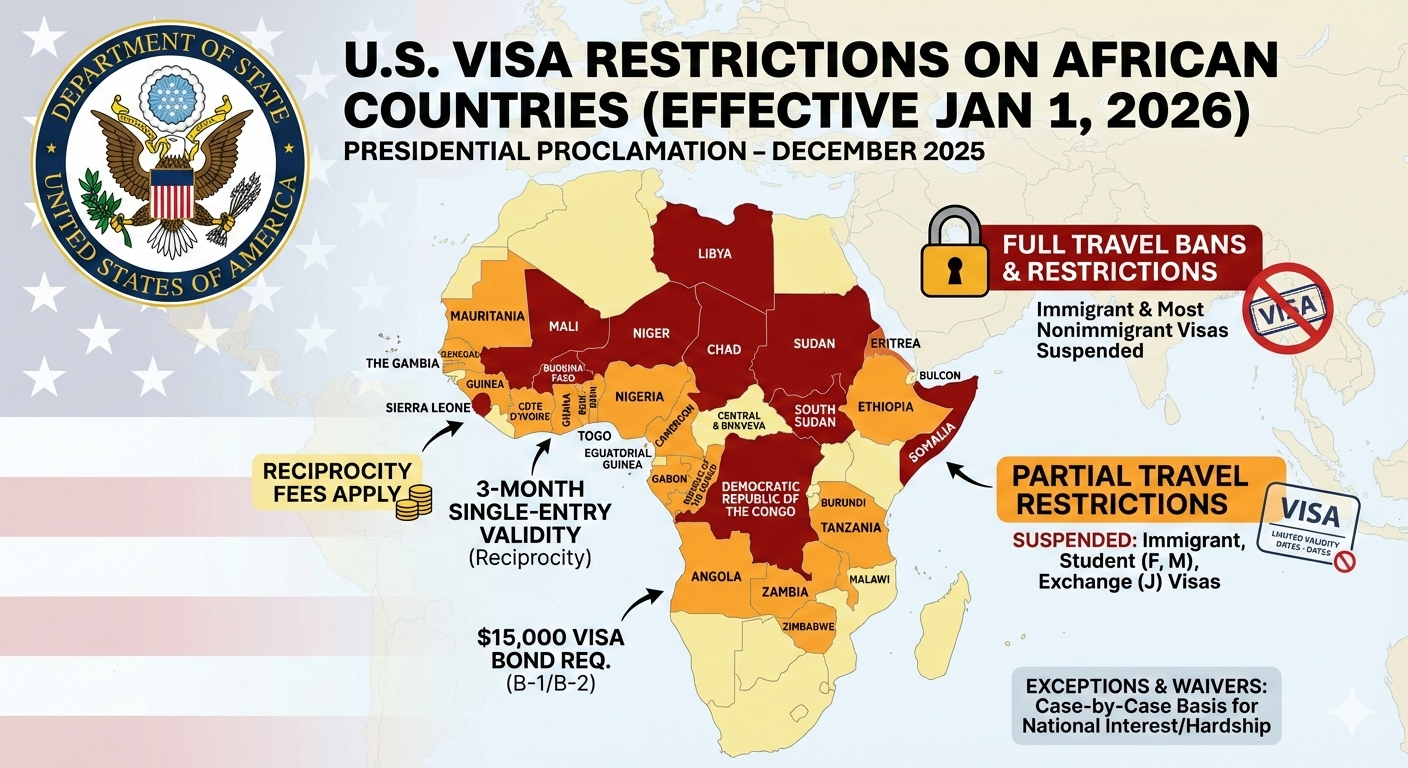
In the waning days of 2025, a profound shift in US foreign policy signaled a new era of geopolitical distance between North America and the African continent. This change, which some analysts have dubbed the “Atlantic Curtain,” arrived in the form of the expansive Presidential Proclamation of December 16, 2025, which significantly curtailed mobility for millions of African nationals. This comprehensive architecture of exclusion—encompassing visa bans, financial barriers, and digital walls—is not merely a response to migration pressure; it is increasingly viewed across Africa as a punitive, ideological pivot that is accelerating the continent’s strategic realignment away from the West.
The New American Architecture of Exclusion
At the core of the US policy is a sweeping set of visa restrictions that expanded the list of nations subject to entry limits to 39 countries—nearly 20% of the world’s nations. The restrictions operate on two distinct tiers:
1. Full Bans: The Cordon of Security
The most severe category, the “Full Ban,” suspends all immigrant and nonimmigrant entry for nationals from several countries, primarily in the Sahel and the Horn of Africa. The December Proclamation added four African nations—Burkina Faso, Mali, Niger, and South Sudan—to this list, citing concerns over terrorism, instability, and deficient vetting processes. The US State Department had explicitly warned Americans about the grave security situation in parts of the continent, with Al-Qaeda-linked groups threatening to overrun certain African nations. However, African leaders in nations like Mali and Niger, which have recently expelled Western forces and pivoted towards Russia, view the total ban as direct retribution for their geopolitical shift and a hostile act against their sovereignty.
2. Partial Bans and the Student Blackout
The new policy also introduced “Partial Restrictions” on nations deemed to have high visa non-compliance or overstay rates, even if they are stable democracies. Most consequentially, Nigeria, Africa’s largest economy and most populous nation, was added to the restricted list. The ban suspended B-1/B-2 (business/tourism) visas, and crucially, extended the restriction to F, M, and J visas—the categories used by students and cultural exchange visitors.
This student visa ban is a catastrophic blow to a relationship long built on educational exchange. Nigeria had been the largest African source of international students in the US, with numbers surging in the 2024-2025 academic year. By severing this bridge, the policy immediately curtails the flow of Africa’s brightest minds to American universities.
The Financial Barrier: A Wealth Test at the Border
Beyond the bans, the State Department deployed two financial instruments that act as a de facto wealth test for African travelers:
- The Visa Bond Pilot Program: This radical policy authorizes consular officers to require applicants from a list of nations—which is overwhelmingly African, including Botswana, Zambia, and Malawi—to post a bond of up to US$15,000 as a prerequisite for visa issuance. For a citizen of Malawi, where the average annual income is around US$540, a US$15,000 bond represents nearly three decades of earnings, effectively making US travel impossible for all but the ultra-elite.
- The Visa Integrity Fee: A universal, non-refundable US$250 surcharge on most nonimmigrant visa applications acts as a discriminatory tax on the Global South. Since no African nation is part of the Visa Waiver Program, the fee is paid by virtually all African applicants on top of the existing US$185 application fee, making a family trip prohibitively expensive.
Fortress Europe and the British Ultimatum
The US move did not occur in isolation. European powers are simultaneously hardening their borders. The United Kingdom, in a policy described as coercive visa diplomacy, threatened a “total suspension of tourist, VIP, and business visas” for nationals from Angola, Namibia, and the Democratic Republic of Congo (DRC). This ultimatum was delivered to force their governments to accept the repatriation of illegal immigrants, explicitly targeting the elites of these countries as leverage. Meanwhile, the European Union is cracking down on visa-free travel and has reformed its Suspension Mechanism, posing an existential threat to the mobility of citizens from island nations like Mauritius and Seychelles. This tightening, along with consistently high Schengen visa rejection rates for African applicants, reinforces the perception that the West is constructing a fortified “paper wall”.
African Reactions: Muted Protests and a Geopolitical Pivot
The immediate official reaction from African capitals to the restrictions was notably “muted.” This silence, however, should not be mistaken for acceptance. It is a strategic calculation by leaders who have “priced in” US hostility and are now actively diversifying their partnerships.
South Africa, a key African heavyweight, remains “unfazed” by US visa policies, with officials suggesting they are simply focused on their own independent foreign policy and forging ties with global partners like the BRICS bloc.
The real backlash is bubbling up from civil society and the next generation of students. Human rights activists have condemned the bonds and bans as “discriminatory,” arguing they penalize stable, largely Black nations based on minor, statistically disproportionate overstay rates. For the thousands of students now barred from the US, years of planning have been wiped out overnight.
This has triggered a rapid and profound geopolitical pivot. As the US closes its doors, African students and business travelers are redirecting their focus. Education consultants report a surge in interest for universities in Canada, the UK (despite its own restrictions), and critically, China, which has been aggressively courting African talent with scholarships and simplified visa procedures.
Conclusion: The Price of Isolation
The visa restrictions of late 2025 mark a definitive turning point. Under the banner of “America First,” the United States has signaled that it views African mobility primarily as a security threat or a demographic risk to be managed, rather than an economic or soft-power opportunity.
The cost of this isolationism will be profound. The US travel and education sectors face a self-inflicted economic wound, projected to lose billions in student tuition and visitor spending. But the long-term consequence is geopolitical. By shutting the door on the world’s youngest and fastest-growing population, is the West eroding its own soft power and accelerating Africa’s strategic pivot to the East? The continent is moving on; as the United States builds its walls, the rest of the world is building the roads, and the traffic is slowly moving away from the West.
